Achieving successful outcomes through clear goal-setting
What gets measured gets managed
But are we measuring the right things? The primary focus should be on WHAT we need to do to reach the desired outcome. Identify those critical activities and set targets around them. Setting the right goals can feel daunting, which is exactly why so many organisations avoid it. The result is reactive management — and that rarely produces successful outcomes.
Clear goal-setting
A lack of clear goals is often the root cause of a failed business strategy. To bring clarity, you can use the SMART model when formulating your objectives (though other frameworks work just as well). Do your goals meet these criteria?
Specific (S)
A clear goal leaves no room for personal interpretation. It must therefore be formulated as specifically and precisely as possible, answering the question of WHAT we are going to achieve. Avoid vague words like "quality" or "efficiency" — instead, use KPIs that measure your own definition of those concepts.
Measurable (M)
To track progress and assess goal achievement, the goal must be measurable — ideally with a defined unit, such as SEK, %, units sold, or similar. A numerical value is recommended, but a binary measure works too, meaning you can answer yes or no to whether the goal has been reached.
Accepted (A)
This may seem obvious, but it is essential that the team driving towards the goal is genuinely behind it in order to achieve maximum impact. Buy-in matters.
Realistic (R)
Striking the right balance — making a goal attainable while still challenging and motivating — can be difficult. It must of course also be realistic given the company's circumstances and financial resources.
Time-bound (T)
Having a clear deadline significantly increases the chances of reaching the goal. That said, don't fall into the trap of working solely with long-term targets. Complement them with short-term objectives, or break long-term goals down into milestones. Review progress regularly, and celebrate wins along the way. Goal management is a proactive process that improves your chances of reaching the outcome you want.
Focus on the factors that drive your results, and set the right type of goals
Having a goal is always a good thing. But if I focus only on the end result — the desired future state — there is a real risk that I will struggle with the activities needed to get there. That is why we should focus on managing activities and setting targets on the things that actually create our results. A financial result is an effect of doing things in a particular way. So what drives our financial results?
Lagging and leading indicators
The terms lagging and leading indicators are often used in this context. Examples of lagging measures include revenue, turnover, customer satisfaction, and market share. They are all effects of various activities and outcomes. To achieve the lagging targets, we use leading indicators, which measure what most influences what we need to do in order to reach them. If revenue is our lagging goal, what could our leading goals be to hit that revenue target? This is where we begin to connect our goal-setting to the results and activities that actually drive it.
Process goals, result goals, and effect goals
The result — often a financial one — is an effect of doing things in a particular way. We therefore need to focus on managing activities and setting targets for the factors that drive our results. Imagine you have a personal goal of running 10 km in 45 minutes. You will not hit that goal without breaking it down into activities with a clear target in mind. The same applies in the workplace.
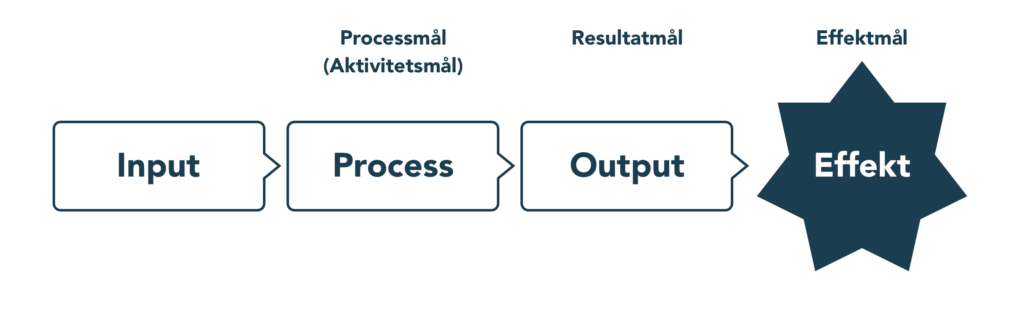
It is quite common to work only with result goals and effect goals. The problem this creates is that it can become difficult to put in place the activities needed to achieve your objectives, which leads to reactive management. At a high level, result and effect goals are usually the most important. But for the people doing the work, the process goal (the activity goal) matters most — it builds understanding and enables clear direction. By complementing result and effect goals with process goals, you shift focus to managing activities and setting targets on what will ultimately create the final result (the effect).
Less is more
One common mistake is having too many goals. Think Less Is More — focus on the factors that drive your results and the effects you want to achieve.
For some this comes naturally; for others it is genuinely challenging. Today it is relatively straightforward to bring in an external consultant to help establish clear, structured goal management. Try searching for consultants with specific expertise and experience on GigPort.