What is ChatGPT and how can AI be used for marketing?
Can AI help you with your marketing?
Can an AI help me create content tailored to a specific product or service and to customers' emotional goals — designed to capture attention, drive engagement, and increase sales? The answer is yes. What's more, the whole thing can be automated using free software.
Our experiment is built in Google Sheets, which uses API calls to return responses directly from OpenAI's ChatGPT. ChatGPT is a public and, for now, free service — though it does require you to create an account. Try it for yourself at https://openai.com.
The results of our experiment
When writing copy for marketing or landing pages, it's important to use language that resonates with customers' emotional goals.
If someone is looking for a course on data-driven optimisation, for instance, they're not simply trying to learn more about data-driven optimisation. They want to become more successful in their career and achieve better results by using the right methods. By demonstrating that you understand your visitors' emotional goals, your copy can have a significant impact on the page's conversion rate.
I'm not suggesting you rely exclusively on AI-generated copy — but it can be a useful source of inspiration and a real time-saver. By entering a product or service into the template, I get back a suggested emotional goal that drives purchases of that product. From that goal, the tool then generates marketing copy built around the product and its emotional hook.
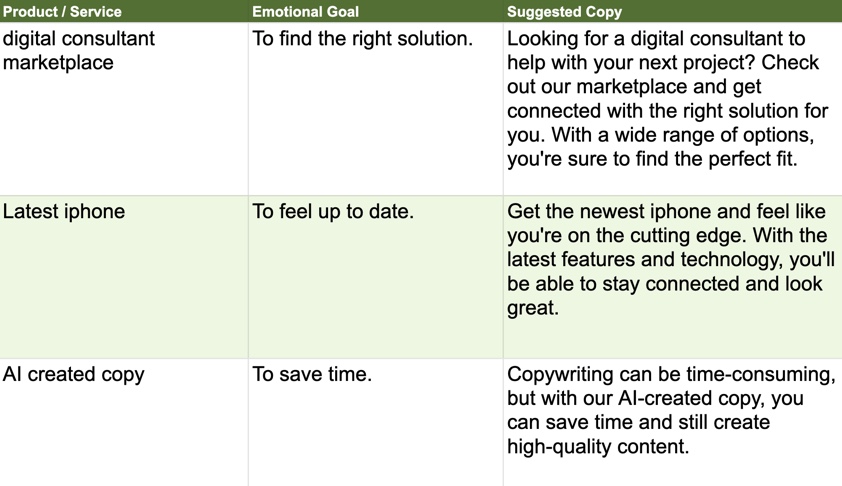
Results from the experiment with ChatGPT
What is ChatGPT
ChatGPT (Generative Pre-trained Transformer) is a chatbot launched by OpenAI in late November 2022 that has taken the world by storm in a very short time — so we're certainly not the first to discover it. Within just the first week, it was estimated to have four million users. ChatGPT is said to perform best in English, but you can get surprisingly good results in Swedish too, as we'll be testing very soon. The range of use cases for this AI is vast. We've only briefly touched on one example of niche content production, but ChatGPT is also capable of writing code, checking functionality, and spotting errors in code strings. Try it for yourself at https://openai.com.
We let ChatGPT speak for itself
Let's put a few questions to ChatGPT in Swedish and see how well it can follow a line of reasoning and maintain context across questions. All questions were asked in Swedish in the order shown, and the answers are reproduced in full from ChatGPT.
What is ChatGPT?
ChatGPT is a language model trained using the latest machine learning technology — specifically the transformer neural network architecture. It is a generative model, meaning it can produce new text based on what it has learned from its training data.
ChatGPT is specifically designed to understand and respond to questions in natural human language, and is frequently used in chatbots or virtual assistants.
What is the goal of ChatGPT?
The goal of ChatGPT is to generate naturally sounding text in human language. It can be used for many different purposes, such as answering questions in a chatbot, automatically generating content, or helping to write emails, articles, and other types of documents. By training the model on a large volume of text, the aim is for the model to understand the meaning of human language — so that it can answer questions and generate text that sounds as natural as possible.
Another important aspect of ChatGPT is its ability to handle context: it can keep track of a conversation and pick it up again later, which makes it particularly useful for chatbots and virtual assistants.
What opportunities does it open up?
There are many different ways to use ChatGPT and other generative language models. Here are a few examples:
Chatbots and virtual assistants: ChatGPT can be used to answer questions and hold conversations in a chatbot or virtual assistant. It can keep track of the context of a conversation and respond to questions in a natural way.
Automatic content generation: ChatGPT can be used to generate content automatically, such as articles, blog posts, emails, and other types of documents. It can also be used to translate text or generate subtitles.
Creative applications: ChatGPT can be used to produce creative works such as stories, poetry, and scenarios. The model can also be used to generate music or audio.
Pre-training for other AI models: ChatGPT can also be used as a form of pre-training for other AI models — it can be used to train other models to understand text or, for example, answer questions in a question-answering system.
NLP applications: The ChatGPT model can also be used for various types of natural language processing (NLP) applications, such as text compression, text summarisation, text classification, and machine translation.
These are just a few examples of possible uses for ChatGPT and generative language models in general. The possibilities are endless as the models continue to evolve and improve.
How can ChatGPT be used to create content and marketing?
There are several different ways to use ChatGPT to create content and marketing material. Here are a few examples:
Training on specific data: The first step is to train the model on data that is specific to the product and its emotional target audience. This may involve gathering text that describes the product, its benefits, and the emotional goals, as well as marketing copy aimed at the target audience.
Generating content: After training, the model can be used to generate different types of content, such as product descriptions, use cases, and other technical documents. The model can also be used to create unique and creative content — such as stories and poetry — related to the product and its emotional target audience.
Generating marketing copy: The model can also be used to generate marketing copy, such as ads, social media posts, web pages, emails, and other types of marketing material. This copy can be tailored to target specific emotional audiences and can also include particular messages and values relevant to the product.
Analysing existing content: The model can also be used to analyse existing content — such as competitors' marketing copy or customer feedback — to gain a better understanding of which messages and values resonate with the product's target audience.
Testing and fine-tuning: After all of the above, you can test and fine-tune the generated content and marketing copy by trialling it with a smaller segment of the target audience, gathering feedback, and using that feedback to refine the model. It's important to note that the training process and the generated content and marketing copy should be reviewed and edited by humans, to ensure they are accurate, relevant, and professional.
What are the benefits of digitalising the consulting market and creating an open marketplace for consultants in technology, IT, leadership, and finance?
There are several benefits to digitalising the consulting market and creating an open marketplace for consultants in technology, IT, leadership, and finance. Here are a few:
Easy and seamless matching: An open marketplace makes it simple for companies and organisations to find the right consultant for their specific needs — whether in technology, IT, leadership, or finance. This gives companies the ability to quickly identify the right consultant and get a collaboration off the ground faster.
A broader range of consultants: An open marketplace gives companies and organisations the opportunity to choose from a wide selection of consultants with different specialisations and experience. This means companies and organisations can find consultants with precisely the skills and experience required for the task at hand.
More efficient use of time and resources: An open marketplace for consultants makes it easy for companies and organisations to find, contact, and hire consultants. This means they can use their time and resources more efficiently by quickly identifying the right consultant for their needs.
Increased competition and lower prices: An open marketplace for consultants can lead to greater competition among consultants, which can result in lower prices for companies and organisations. Global availability: An open marketplace for consultants in technology, IT, leadership, and finance gives companies and organisations the opportunity to find consultants from anywhere in the world.
Thank you very much for your answers. I hope we can find a rewarding collaboration in the future.
You're welcome! I hope I've been able to help you with your questions. I'm here to assist if you need more information in the future. It sounds like you have some interesting ideas about how ChatGPT can be used, and I hope you find a rewarding collaboration. Don't hesitate to get in touch again if you have more questions or if there's anything else I can help with.
Easy and seamless matching
As described above, there are many benefits to finding the right consultant with the help of companies like GigPort. Try searching for consultants with specific skills and experience at GigPort.